"Polymorphism" is a greek word, "poly" means many and "morph" means forms.
In object oriented programming paradigm Polymorphism is expressed as one object behaving as multiple forms. One function behave in different forms.
Showing posts with label OOP. Show all posts
Showing posts with label OOP. Show all posts
Tuesday, 28 February 2017
Polymorphism in OOP

Inheritance in OOP
Inheritance
One of the most important concepts of object oriented programming is Inheritance. Inheritance is a mechanism of acquiring features and behaviors of one class called as base or parent class into another class called as derived class.
Inheritance implements a IS-A relationship.
Advantages of inheritance
- Code re-usability
- Reduction in code size
- Improve code readability
- Code extensible support by overriding base class method into derived class
Disadvantage of inheritance
- Tight coupling between base class and child class
- Performance of your program is affected if inheritance is not implemented properly.
- Many unused data members remain unused & memory is allocated for the same.
Different types of inheritance
- Single Inheritance
When a derived class is created from a single base class.

C# Example
public class Parent
{//Definition}
public class Derived : Parent{//Definition}
- Multi-Level Inheritance
When a derived class is created from another derived class is called as multi-level inheritance
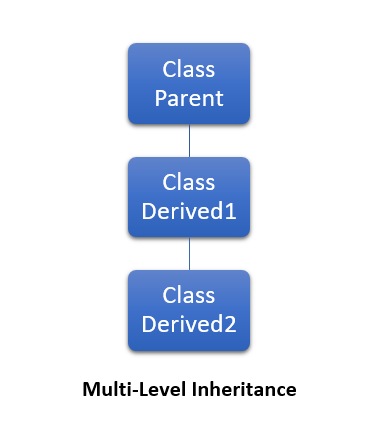
C# Example
ppublic class Parent
{//Definition}
public class Derived1 : Parent{//Definition}
public class Derived2 : Derived1{//Definition}
- Multiple Inheritance
When a derived class is created from more than one class then it is called as multiple inheritance. This type of inheritance is not supported in C# or .Net

This type of inheritance is not supported in C# or .Net
- Hierarchical Inheritance
When a multiple derived class is created from one single class then it is called as Hierarchical inheritance.

C# Example
public class Parent{//Definition}
public class Derived1 : Parent{//Definition}
public class Derived2 : Parent{//Definition}
public class Derived3 : Derived1{//Definition}
public class Derived4 : Derived1{//Definition}
public class Derived5 : Derived2{//Definition}
public class Derived6 : Derived2{//Definition}
- Hybrid Inheritance
This is combination of more than one inheritance. It may be a combination of Multilevel and Multiple inheritance or Hierarchical and Multilevel inheritance or
Hierarchical and Multilevel and Multiple inheritance.
- Why C# does not support multiple inheritance?
C# does not support multiple inheritance because of diamond problem. To know more about diamond problem please refer below link
https://en.wikipedia.org/wiki/Multiple_inheritance#The_diamond_problem
- As we know multiple inheritance is not supported by C# or .Net what is the other way to achieve multiple inheritance in C# or .Net?
We can achieve similar functionality using interface in C#.
- Is static class can be inherited ?
Static class can not be inherited. C# complies static class as sealed abstract class hence static class cannot be inherited in c#.
- How to make normal class non inheritable c#?
Using sealed keyword in c# we can stop class from further inheriting it.
Tuesday, 11 December 2012
S.O.L.I.D. Principles in Object Oriented Programming
Single Responsibility Principle (SRP)
It states that every object should have a single responsibility, and that responsibility should be entirely encapsulated by the class. There should not be more than one reason to change the class. This means class should be designed for one purpose only. This principle states that if we have 2 reasons to change for a class, we have to split the functionality in two classes. Each class will handle only one responsibility and on future if we need to make one change we are going to make it in the class which handles it. When we need to make a change in a class having more responsibilities the change might affect the other functionality of the classes.
Example- Sales Order class: This class is using for CRUD functionality of Sales Order, and then it should not have any method to MAP Sales Order attributes with Database columns, because later if there is any new column added in Database the class need to be modified which is violating the rule of Single Responsibility Principle.
Open/Close Principle (OCP)
It states that Class should be open for extension, but close for modification. At first, this seems to be contradictory: how can you make an object behave differently without modifying it? The answer: by using abstractions, or by placing behavior (responsibility) in derivative classes. In other words, by creating base classes with override-able functions, we are able to create new classes that do the same thing differently without changing the base functionality.
Liskov Substitution Principle (LSP)
Basically when we designed a class, we use maintain Class hierarchies. We must make sure that the new derived classes just extend without replacing the functionality of old classes. Otherwise the new classes can produce undesired effects when they are used in existing program modules.
LSV states that if the module using any base class, then the reference to the Base class can be replaced with a Derived class without affecting the functionality of the program module.
Example: - A typical example that violates LSP is a Square class that derives from a Rectangle class, assuming getter and setter methods exist for both width and height. The Square class always assumes that the width is equal with the height. If a Square object is used in a context where a Rectangle is expected, unexpected behavior may occur because the dimensions of a Square cannot (or rather should not) be modified independently. This problem cannot be easily fixed: if we can modify the setter methods in the Square class so that they preserve the Square invariant (i.e. keep the dimensions equal), then these methods will weaken (violate) the post conditions for the Rectangle setters, which state that dimensions can be modified independently. If Square and Rectangle had only getter methods (i.e. they were immutable objects), then no violation of LSP could occur.
Interface Segregation Principle (ISP)
It states avoid tying a client class to a big interface if only a subset of this interface is really needed. Many times you see an interface which has lots of methods. This is a bad design choice since probably a class implementing. . This can make it harder to understand the purpose of a component, but it can also cause increase coupling, where by components that make use of such a component are exposed to more of that components capabilities that are appropriate.
The Interface Segregation Principle (or ISP) aims to tackle this problem by breaking a components interface into functionally separate sub-interfaces. Although a component may still end up with the same set of public members, those members will be separated into separate interfaces such that a calling component can operate on the component by referring only to the interface that concerns the calling component.
Dependency Inversion Principle (DIP)
In an application we have low level classes which implement basic and primary operations and high level classes which encapsulate complex logic and rely on the low level classes. A natural way of implementing such structures would be to write low level classes and once we have them to write the complex high level classes. Since the high level classes are defined in terms of others this seems the logical way to do it. But this is not a flexible design. High-level modules should not depend on low-level modules. Both should depend on abstractions. Abstractions should not depend on details. Details should depend on abstractions.
Subscribe to:
Posts (Atom)
-
 The Major components of WPF Architecture are Presentation Framework, Presentation Core and Media Integration Layer. The architecture divid...
 -
Summary/Definitions: All the below interfaces are parts of the System.Collections .Net assembly. IEnumerable: Exposes the enu...
-
 Inheritance One of the most important concepts of object oriented programming is Inheritance. Inheritance is a mechanism of acquiring fe...